---o0o---
Sunday, February 09, 2014
Saturday, February 08, 2014
Friday, February 07, 2014
Sign from Seattle's now defunct Funhouse club
This is the sign from the Funhouse, a club located across the street from The Space Needle. It closed earlier this year.
Photo courtesy of Carol M. Highsmith's America, Library of Congress, Prints and Photographs Division.
---o0o---
Thursday, February 06, 2014
Wednesday, February 05, 2014
Jack with 1/3 of his sisters-in-law
By Jack Brummet
With my beautiful sis-in-laws Megan & Mary at the Matt & Emily wedding in Yosemite in October. It's hard to believe I've known these two women 40 years, since neither of them even appears to be 40. Really cool wavy artifacting in the photo...I don't know who took this pic, but it may be actual film...like one of those disposable cameras people pass around at weddings?
---o0o---
Tuesday, February 04, 2014
Poem: The Bay
By Jack Brummet
Between
what we do
And what we'd like to think we'd do
Lies a vast bay of denial and delusion
---o0o---
Lies a vast bay of denial and delusion
---o0o---
President Nixon and Bob Haldeman attempt to neutralize Johnny Cash & Johnny Cash's sweet revenge a couple years later
By Pablo Fanque, National Affairs Editor
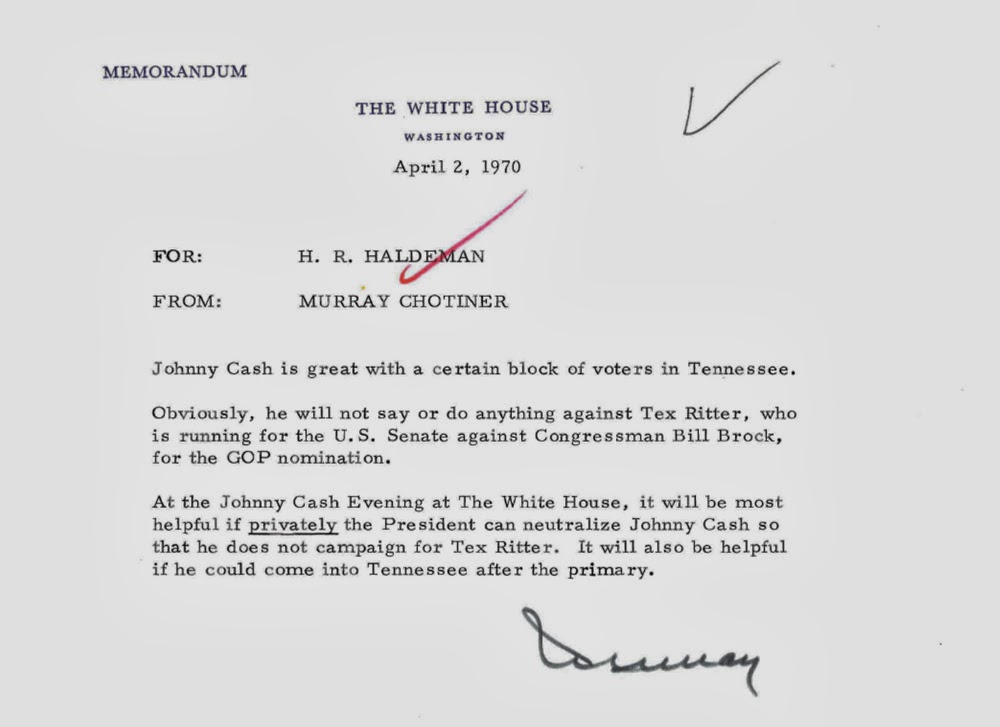
In 1970, President Richard Nixon and Bob Haldeman hoped to politically neutralize Johnny Cash, and convince him not to campaign for Tex Ritter in a a Tennessee U.S. Senate race. Here is the White House memo, now housed at The Nixon Library.

Mental Floss, in a post March 5, 2012, [ed's note: I don't think Mental Floss knew about this letter, or the earlier meeting referred to by Haldeman] reported that two years after this memo, "In July 1972, Cash sat down with Richard Nixon in the White House’s Blue Room. The country music superstar had come to discuss prison reform, and the media was present, eager to report the results. Nixon thought he’d break the ice, and asked, “Johnny, would you be willing to play a few songs for us?” “I like Merle Haggard’s 'Okie From Muskogee' and Guy Drake’s 'Welfare Cadillac.'" Both songs were satirical expressions of right-wing disdain for Vietnam protesters and hippies, and one for for poor people who cheat the welfare system."
Cash said he didn't know those songs, but had some of his own. Cash started with “What Is Truth?” a great anti-war song that celebrated the protesting, long haired youth of America.
From Metal Floss again: "Nixon sat listening with a frozen smile. Cash continued the assault with “The Man in Black,” a song that explained how his fashion preference represented his solidarity with the oppressed, the sick, the lonely, and the soldiers (“Each week we lose a hundred fine young men”). Cash then capped off his mini-concert with “The Ballad of Ira Hayes,” about the plight of Native Americans, in particular one of the soldiers who raised the flag at Iwo Jima. Hayes returned home to be decorated, but couldn’t deal with the guilt he felt over surviving the war when so many of his friends didn’t. He drank himself to death."
In 1970, President Richard Nixon and Bob Haldeman hoped to politically neutralize Johnny Cash, and convince him not to campaign for Tex Ritter in a a Tennessee U.S. Senate race. Here is the White House memo, now housed at The Nixon Library.

Mental Floss, in a post March 5, 2012, [ed's note: I don't think Mental Floss knew about this letter, or the earlier meeting referred to by Haldeman] reported that two years after this memo, "In July 1972, Cash sat down with Richard Nixon in the White House’s Blue Room. The country music superstar had come to discuss prison reform, and the media was present, eager to report the results. Nixon thought he’d break the ice, and asked, “Johnny, would you be willing to play a few songs for us?” “I like Merle Haggard’s 'Okie From Muskogee' and Guy Drake’s 'Welfare Cadillac.'" Both songs were satirical expressions of right-wing disdain for Vietnam protesters and hippies, and one for for poor people who cheat the welfare system."
Cash said he didn't know those songs, but had some of his own. Cash started with “What Is Truth?” a great anti-war song that celebrated the protesting, long haired youth of America.
From Metal Floss again: "Nixon sat listening with a frozen smile. Cash continued the assault with “The Man in Black,” a song that explained how his fashion preference represented his solidarity with the oppressed, the sick, the lonely, and the soldiers (“Each week we lose a hundred fine young men”). Cash then capped off his mini-concert with “The Ballad of Ira Hayes,” about the plight of Native Americans, in particular one of the soldiers who raised the flag at Iwo Jima. Hayes returned home to be decorated, but couldn’t deal with the guilt he felt over surviving the war when so many of his friends didn’t. He drank himself to death."
---o0o---
Subscribe to:
Posts (Atom)