By Jack Brummet, Music and Society Editor
Woody Guthrie was a great man, and a great writer. Yeah, I didn't say great singer, but I like his singing. Any fool can get all Frenchified and rococo. It takes a genius to get simple. This genius fled Dust Bowl Oklahoma in the 30’s and became famous a few years later for his songs
Dust Bowl Ballads. For most of the rest of his life he would be a roamer and a troubadour. He is one of the great American songwriters, right up there in the pantheon with Stephen Foster, Gershwin, Bob Dylan, Cole Porter, Johnny Mercer, Duke Ellington, Irving Berlin and others. He may be at the top of the rockpile. . .in my booklet, at least.
Woody Guthrie loved America as deeply as anyone ever has. He thrived on the people and the idiom. We remember him mainly for his songs, but he was also a wonderful writer. You may have heard his songs like
So Long It’s Been Good To Know You, I Ain’t Got No Home In This World Anymore, Dust Can’t Kill Me, Union Maid, Reuben James, Planewreck At Los Gatos, and over a thousand more songs.
 He hit 46 of these United States,
 usually with just his guitar and a toothbrush. One of the songs inspired by a trip, This Land Is Your Land, should probably be the
national anthem. Woody’s influence has been monolithic, although most of us have only experienced Woody absorbed and filtered through Bob Dylan, Ramblin' Jack Elliott, Phil Ochs, Allen Ginsberg, Joan Baez, or Wilco, among hundreds of others. His work has been passed down through cultural
osmosis.
When the notorious House Unamerican Activities Committee (HUAC) began collecting names and driving the blacklisting, Woody was not afraid. He had nothing to hide, and the committee, like the dust, couldn’t kill him.
Some people considered The B.P.A. and the Grand Coulee Dam tributes to an "experiment in American socialism." These huge public works projects were "a revolutionary slap at the private enterprise system." Guthrie’s Columbia River songs reflect his optimism the dam would bring an increased standard of living to the people. One of Guthrie’s most famous songs,
Pastures of Plenty, presents an idealist's vision of public irrigation and electrification:
I think of the dust and the days that are gone,
And the day that’s to come on a farm of our own;
One turn of the wheel and the waters will flow
‘Cross the green growing field, down the hot thirsty row.
Look down in the canyon and there you will see
The Grand Coulee shower her blessings on me;
The lights for the city for factory, and mill,
Green Pastures of Plenty from dry barren hills.
Woody was profoundly shocked by what happened to the poor Okies who left the Dust Bowl for California, by how they were killed, beaten and starved out by the State Police and farm owners. Something had gone very wrong with this great country. His song about Pretty Boy Floyd summed up his feelings:
Now as through this world I ramble
I’ve seen lots of funny men.
Some will rob you with a six-gun
And some with a fountain pen.
But as through this life you travel
And as through this life you roam,
You’ll never see an outlaw
Drive a family from its home.
Woody believed the Great Depression and dust bowl were caused by the Big Boss Man and King Coal. He wasn’t singing anymore about lost love; he was pointing fingers.
One night, on a radio show, he hit it on the head:
"A policeman will just stand there and let a banker rob a farmer or a financier rob a working man. But if a farmer robs a banker, you would have a whole army of cops out shooting at him. Robbery is a chapter of etiquette.”
Woody Guthrie was a patriot, but he was no Democrat. As he said in that same radio broadcast:
“I ain’t a communist necessarily, but I been in the red all my life.”
By 1947, Woody was working on his second marriage, to Marjorie. Between his travel and performances, he lived with her and his daughter Cathy Ann in Brooklyn. Woody nicknamed her Stackabones, and wrote his famous children’s songs for (and with) her:
Why can’t a dish break a hammer?
Why, or why, oh why?
Because a hammer’s
got a pretty hard head.
Goodbye goodbye goodbye.
Why can’t a bird
break an elephant?
Why, oh why, oh why?
Because an elephant’s got a
pretty hard skin.
Goodbye goodbye goodbye.
He published stories about Stackabones. Cathy Ann was very much like Woody, singing, rhyming, and always playing with words. One day her dress caught on fire and she was badly burned. She was singing when Woody got to the hospital, but she died that night.
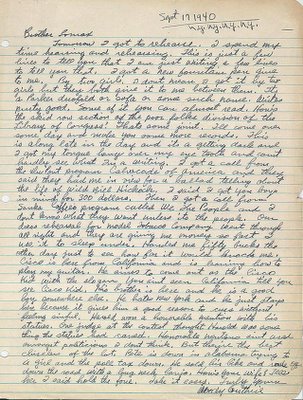 Woody sat down and wrote
: “And the things you fear most shall surely come upon you.” It seemed like everyone he ever loved was doomed to go up in flames. There were fires in his childhood. The brand new family house had burned down. His sister Nora died when her dress caught fire. Just she and her mother were at home. She was singing when Woody saw her in the hospital too. There were many rumors about her death. There were other fires. And there was his mother’s problem. After her daughter died, she became more and more nervous and remote until finally she spent all her days wandering through town like she was lost. No one knew what to do.
There was another fire. Woody’s mother was holding a kerosene lamp and when his father woke up, he was on fire.
When Woody came home the next day after a visit with relatives, a neighbor told him his father was in the hospital and his mother had been put in an insane asylum. In his wonderful book Bound For Glory, he compared his own restlessness and nervousness to his mother’s condition.
After the death of Stackabones, Woody lost his spark. He and Marjorie soon had other children (including Arlo), but he never took the same interest. He had become unpredictable. He still wrote hundreds of pages each week, and always had new songs in the works. But they weren’t like the old ones. He just couldn’t concentrate anymore.
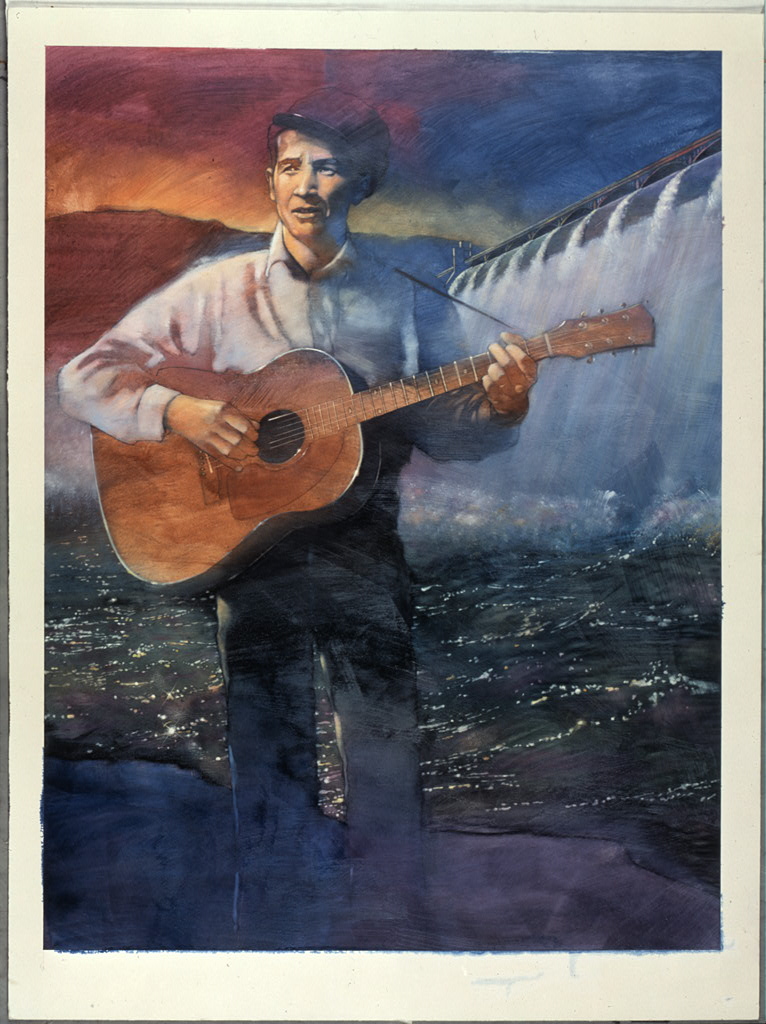
 A painting of Woody at the Columbia dam,
about which he wrote some of his greatest
songs
Marjorie forced him to move out
A painting of Woody at the Columbia dam,
about which he wrote some of his greatest
songs
Marjorie forced him to move out when he attacked their son Arlo one day. Woody went into the hospital to cure himself of alcoholism, and a young doctor figured out his problem. He asked Woody questions about his parents and grandparents, and diagnosed him with Huntington’s Chorea, called chorea because of the violent dance-like movements of its victims (the root of the word choreography). Huntington’s Chorea is an inherited degenerative disease and a victim’s offspring stand a fifty-fifty chance of getting the disease. The course of the illness is long and savage.
The changes in Woody occurred so slowly that few of his friends really noticed. Almost everyone chalked it up to drink, or said “Well, that’s just Woody. That’s the way he walks and talks." Some people avoided him now. He slurred his words and staggered and was becoming less and less capable of working at all.
 Bob Dylan's copy of Woody's Book
Bound For Glory
Bob Dylan's copy of Woody's Book
Bound For Glory
When Woody was trying to concentrate, he wrote his name everywhere. . .on walls, on people’s books, on pieces of paper. Woody Guthrie. Woody Guthrie. It was almost as if he was trying to convince himself he really DID exist.
One day he was lighting a fire and the gas can exploded. His arm could no longer hold a guitar very well.
Woody checked into the State Hospital in Queens, and with the exception of visits with friends on weekends, he lived there the rest of his life.
His son, the musician Arlo Guthrie talked about him to Rolling Stone magazine:
“I remember him coming home from the hospital and taking me out to the backyard, just him and me, and teaching me the last verses to This Land Is Your Land because he thinks if I don’t learn them no one will remember. He can barely strum a guitar now and—can you imagine?—his friends think he’s crazy or drunk and they stick him in a green room with all these crazy people…”
“All of a sudden everyone is singing his songs. Kids are singing This Land Is Your Land in school and people are talking about making it the national anthem. Bob Dylan and the others are copying him. And he can’t react to it. Here’s the guy who had all these words and now that he’s really big, he can’t say anything.”
Only Shakespeare could write something that terrible. Woodrow Wilson Guthrie died in 1967, in his fifties. Some experts believe the disease may have enhanced his rhyminess and wordplay, and acted as a creative spur like alcohol and drugs have worked on others.
As the cells died in his brain, it rewired itself, forcing new and wonderful pathways between the nerve synapses. This also led to the not-so-wonderful behavior his family and friends saw. Just like his mother. Starved from all that work, his nerves short-circuited.
Woody and the disease are so bound up together, it’s hard to know where it started and Woody began. No one really knows if the disease starts when you are 14, or in your later years. It cannot be cured. It cannot be predicted in advance. Research is ongoing now, mainly because of what happened to Woody.
Most importantly, of course, is not the disease, but his music and his books. When we sing his most famous song, we sing the first verses. The last verses he tried to teach Arlo are probably politically pink at best, and they were the ones Woody hoped would survive:
In the squares of the city by the shadow of the steeple,
Near the relief office I saw my people
And some were stumbling and some were wondering if
This land was made for you and me.
As I went rambling that dusty highway
I saw a sign that said Private Property
But on the other side it didn’t say nothing.
That side was made for you and me.
Some of the photographs and images of Woody are copyrighted and unlicensed. However, the individual who uploaded this work to Wikipedia, and first used it in an article, as well as subsequent persons who place it into articles, asserts that this use qualifies as fair use of the material under United States copyright law. All This Is That is using the photo under the Fair Use provisions of the copyright act as well, as those provisions apply to scholarly work.
---o0o---
All This Is That contains copyrighted material the use of which has not always been specifically authorized by the copyright owner. We make these materials available to advance the understanding of political, economic, literary, artistic, and social issues. In some cases we satirize, parody, or lampoon materials from other sources. We believe this constitutes a 'fair use' of copyrighted material as provided for by section 107 of the US Copyright Law. In accordance with Title 17 U.S.C. Section 107, the material on this site is distributed without profit for research, educational, and entertainment purposes. If you wish to use copyrighted material from this site for purposes of your own that go beyond 'fair use', please read and follow our Creative Commons Attribution 3.0 license and attribute the work to All This Is That, along with our URL (http://jackbrummet.blogspot.com).

 By Jack Brummet, Music and Society Editor
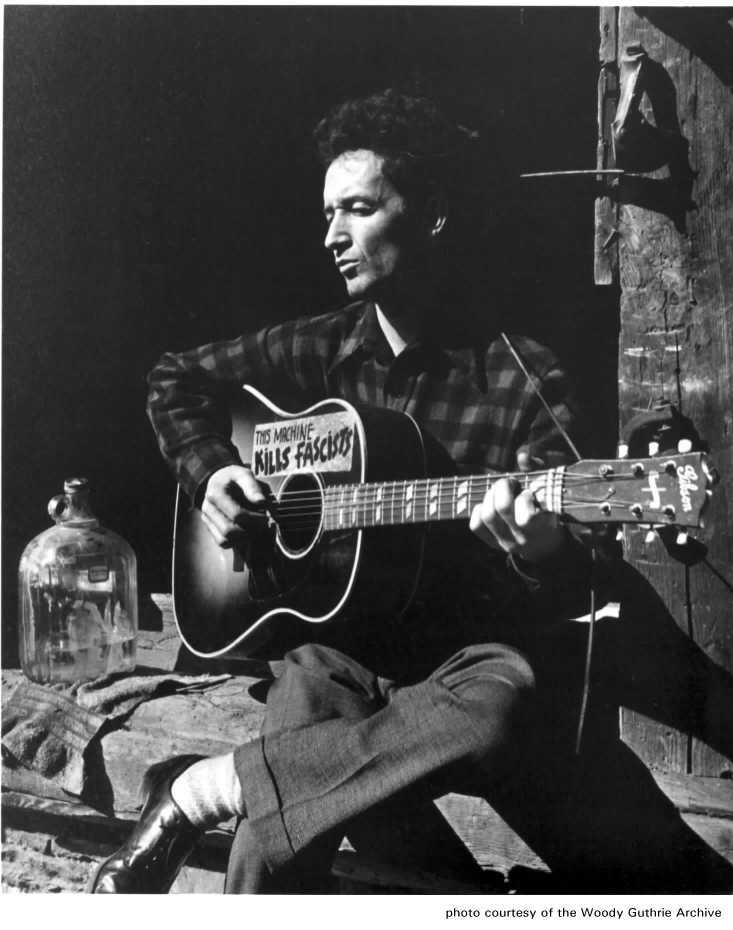
 He hit 46 of these United States, usually with just his guitar and a toothbrush. One of the songs inspired by a trip, This Land Is Your Land, should probably be the national anthem. Woody’s influence has been monolithic, although most of us have only experienced Woody absorbed and filtered through Bob Dylan, Ramblin' Jack Elliott, Phil Ochs, Allen Ginsberg, Joan Baez, or Wilco, among hundreds of others. His work has been passed down through cultural osmosis.