Since I am in Florida, and this computer is slow, I decided to put up a leftover for today's posting. An oldie but goodie. In theory, I'll write something tomorrow. . .but there are a lot of sirens here calling me. . .most of all swimming in that warm water. We'll see...you may get leftovers again tomorrow. Jack in Jensen Beach, FLA
Six hours into the surprise visit, he lumbers on.
My brain unsnaps from its moorings
and drifts like a drunken dirigble
into the torrent of everything I've seen,
smelled, eaten, licked, drunk,
smoked, touched, read, watched, and heard.
It's like he's been talking weeks now
and I remember Nikita Kruschev
on the television at the UN, flashing
those bad teeth and that goofy smile,
pounding those oxfords alive.
I try but I can't quite hear him;
I hear my friend narrating himself.
Things have gotten so out of hand that
I remember today is Renoir's 164th birthday
and I don't even like his painting,
but, hey, at least he threw in some nudes.
He looking at me! What did I miss?
He looks for a yes and keeps talking.
"Yeah," I say, "right. . .yeah." I think about
Motherwell's Reconciliation Elegy
and how he charged around the studio,
rolling vast turgid highways
of black oil over acres of canvas.
I think about Alice Neel
painting all those people
and what they thought
when they saw the final product
or what people thought when they saw
the first Cubist or Dada paintings.
My friend looks for a show of interest.
Yes! By all means, encourage him.
I cock an eyebrow. He revs back up
and I think about my favorite color,
that mid-palette blue...a blue bisque,
the color of my grandma's cameo brooch...
vibrantly subtle...is that possible?...
yes, it's the color of Della Robbia's Florentine ceramics.
He goes on about old times, about how it was then,
way way way back when when when
when we were all back where, back when, doing what
with, for, and to whom. My brains coughs up chimes,
resonations, cross-references, cerebral links,
odors, tinkles, cues, and subtle whiffs of distractions.
I hear Charlie Parker play Carvin' the Bird
somewhere in my head and it segues into
Black Throated Wind and lurches into
Foggy Mountain Breakdown. He jumps
from childhood to yesterday, in between, and back.
I nod and pick up the reverie, falling, falling
back, back, back to the night my daughter was born.
It was as quiet as a painting in Berkeley,
driving at three a.m. on Telegraph Avenue
toward Oakland, to the delivery room.
I saw a new moon hung on our old sky.
We watched the monitor and waited.
When her robber-stockinged face came down,
one bleat to the rafters started us all breathing again.
He's buzzing in my left ear
and the rhythms say I am safe.
I think about dreams--not drifting
like this, but real R.E.M. dreams:
I don't know which is better,
to dream it or see it,
to see it right now,
or to have seen it.
I don't know which is better,
the memory or the thing itself.
The memory can be repeated forever
but loses fidelity like an old record
and the fictions your mind confects
start filling in the gaps
until the memory becomes a framework
for what we wanted to be, or what should have been.
He nudges me, waiting for a yes, the go-ahead sign.
Yeah baby, take it on home. I think about Casey Stengel.
He suspects I am drifting over the hills and far away.
I nod "um." It is the sun's birthday
and where did the crows go? When he jumps to El Toro,
my mind starts sleepwalking from Boot Camp.
I wonder if I will ever get to Palestine,
or if there will ever be another Palestine,
or if I will get back to Seville or Tetuan,
Chora Sfokion or Brooklyn, Heraklion or Hoboken,
Vinaroz or the Delaware Water Gap, if I will ever see
Leningrad or Katmandu, and I wonder
if I would want to see Calcutta, Johannesburg,
Bhopal, Cleveland, Camden, or Port-au-Prince?
I don't know which is easier:
to listen or pretend to listen?
I think about bottles of beer
chilling in a tub of cracked ice.
Sexy rivulets of water fall down bottles
glistening in the hot sun.
Even my nose is tired.
Should I pee, or hold it?
Should I hold it and focus
on the distraction?
What did Gertrude Stein mean
when she wrote about those
"Pigeons In The Grass, Alas?"
Was it the pigeons or the grass
or the pigeons and the grass aggregated?
I want to bang my head on the wall
to dull the pain between my ears,
and he's warming up for the stretch.
A pipe doesn't slow him down and the wine
just keeps his throat supple, his voice nimble,
and the memories and word torrent flowing.
He talks about the Marines
and six years marching, marching marching
on the parade ground erect and spitshined,
marching, saluting, dreaming, marching, yes-sir-ing.
I remember Nick Gattuccio's name
means Sicilian Dogfish and the time we drained
a demi-john of Chianti in Florence.
He tells me twenty things I don't want to know
and ten I'm indifferent about for every one I do.
He remembers where he left off
and murmurs a bridge to the next installment.
I think about the firefall of light I saw that day
on a rising skyscraper.
The welder is a star thrower, and constellations
of pale yellow sparks tumble from a heaven
of beams and girders strung with wire and pipe.
Those sparks are like his words, falling down iron bars
to disappear like fugitives in a white lake of sparks.
---o0o---
Sunday, February 19, 2006


Saturday, February 18, 2006
Poem: I'm here
When I'm not here
I'm often there
Which is anywhere
That's not here.
I'm there
But not all there.
I have to be
A little here
To be there
And a little there
To be here.
Being here
Or being there
Is not being everywhere.
When you go anywhere
You leave a little bit behind,
Shedding pieces
Here there and everywhere.
If you're not here
And you're not there
You are somewhere
Neither here nor there
And somewhere
Could be anywhere
But can't be
Everywhere.
I saw a bear.
Where? Over there.
---o0o---
I'm often there
Which is anywhere
That's not here.
I'm there
But not all there.
I have to be
A little here
To be there
And a little there
To be here.
Being here
Or being there
Is not being everywhere.
When you go anywhere
You leave a little bit behind,
Shedding pieces
Here there and everywhere.
If you're not here
And you're not there
You are somewhere
Neither here nor there
And somewhere
Could be anywhere
But can't be
Everywhere.
I saw a bear.
Where? Over there.
---o0o---
Friday, February 17, 2006
Am I becoming a Buddhist? -- more on copyrights and the promiscuity of our artistic work on the internet
Doing a search for a poem I wrote and published here (but misplaced), I found it. Once, on All This Is That, and once on another site. This other site had four of my poems, all reproduced perfectly, word for word. The only thing missing was my name. My poems became her poems by merely deleting those two words.
Naturally, I was outraged. And then I started thinking, "well, Jack, what about all those photographs you so cavalierly snag and reproduce, or incorporate into collages and paintings?" Do I really think they are all public domain? No. Do I believe I am using them under the Fair Use provisions of the copyright act? Yes. Do I credit the owners when I can find their names? Usually.
So, I am taking a Buddhist approach to infringement. I would have been happy to see the poems reprinted, if they'd use my name. But since they didn't, I'm just going to be glad someone liked them enough to appropriate them. I still wrote them, after all. We can both take credit for them. Forgive and forget.
I also take comfort in, and was inspired by, Woody Guthrie's approach. . .a more egalitarian, sharing folksy-oriented approach (although I do admit to being a bit more of a capitalist than Woody). I just wrote about this here.
I didn't even send her an email. I almost put a link to her blog. . .but hey, I'm not that forgiving! My outrage has subsided into amusement. So, I am not quite a Buddhist yet. . .although I now appear to be surrounded by boddhisatvas!
---o0o---
Naturally, I was outraged. And then I started thinking, "well, Jack, what about all those photographs you so cavalierly snag and reproduce, or incorporate into collages and paintings?" Do I really think they are all public domain? No. Do I believe I am using them under the Fair Use provisions of the copyright act? Yes. Do I credit the owners when I can find their names? Usually.
So, I am taking a Buddhist approach to infringement. I would have been happy to see the poems reprinted, if they'd use my name. But since they didn't, I'm just going to be glad someone liked them enough to appropriate them. I still wrote them, after all. We can both take credit for them. Forgive and forget.
I also take comfort in, and was inspired by, Woody Guthrie's approach. . .a more egalitarian, sharing folksy-oriented approach (although I do admit to being a bit more of a capitalist than Woody). I just wrote about this here.
I didn't even send her an email. I almost put a link to her blog. . .but hey, I'm not that forgiving! My outrage has subsided into amusement. So, I am not quite a Buddhist yet. . .although I now appear to be surrounded by boddhisatvas!
---o0o---
Woody Guthrie on copyright laws
 "This song is Copyrighted in U.S., under Seal of Copyright #154085, for a period of 28 years, and anybody caught singin it without our permission, will be mighty good friends of ourn, cause we don't give a dern. Publish it. Write it. Sing it. Swing to it. Yodel it. We wrote it, that's all we wanted to do."
---o0o---
Thursday, February 16, 2006
Woody Guthrie's transit and eclipse: "I been in the red all my life"
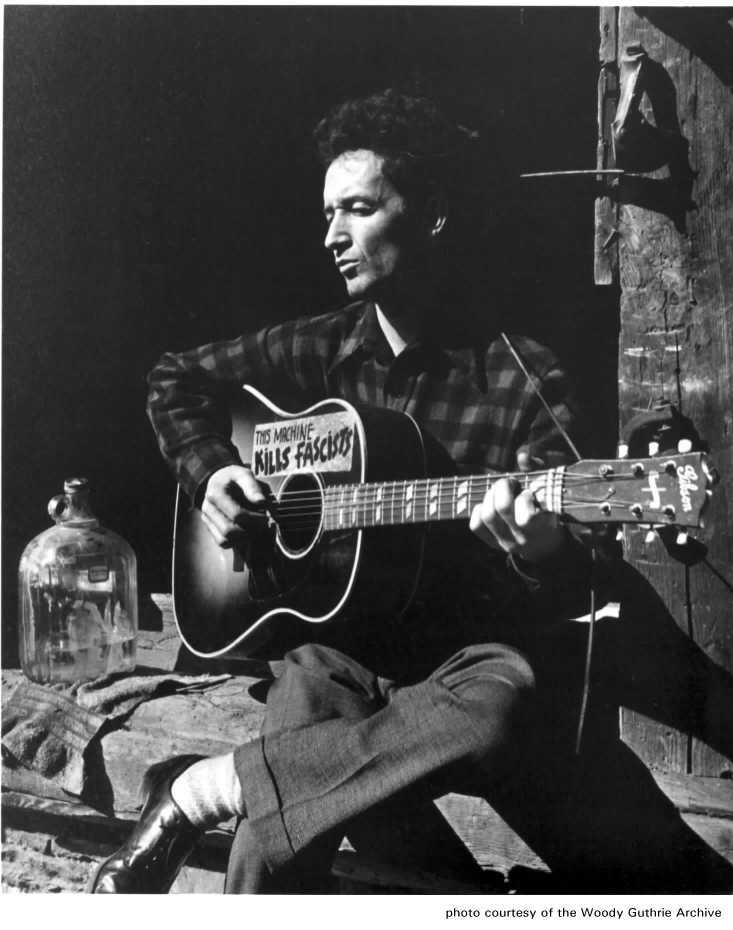 Woody Guthrie was a great man, and a great writer. Yeah, I didn't say great singer, but I like his singing. Any fool can get all Frenchified and rococo. It takes a genius to get simple. This genius fled Dust Bowl Oklahoma in the 30’s and became famous a few years later for his songs Dust Bowl Ballads. For most of the rest of his life he would be a roamer and a troubadour. He is one of the great American songwriters, right up there in the pantheon with Stephen Foster, Gershwin, Bob Dylan, Cole Porter, Johnny Mercer, Duke Ellington, Irving Berlin and others. He may be at the top of the rockpile. . .in my booklet, at least.
Woody Guthrie loved America as deeply as anyone ever has. He thrived on the people and the idiom. We remember him mainly for his songs, but he was also a wonderful writer. You may have heard his songs like So Long It’s Been Good To Know You, I Ain’t Got No Home In This World Anymore, Dust Can’t Kill Me, Union Maid, Reuben James, Planewreck At Los Gatos, and over a thousand more songs.
 He hit 46 of these United States, usually with just his guitar and a toothbrush. One of the songs inspired by a trip, This Land Is Your Land, should probably be the national anthem. Woody’s influence has been monolithic, although most of us have only experienced Woody absorbed and filtered through Bob Dylan, Ramblin' Jack Elliott, Phil Ochs, Allen Ginsberg, Joan Baez, or Wilco, among hundreds of others. His work has been passed down through cultural osmosis.
When the notorious House Unamerican Activities Committee (HUAC) began collecting names and driving the blacklisting, Woody was not afraid. He had nothing to hide, and the committee, like the dust, couldn’t kill him.
Some people considered The B.P.A. and the Grand Coulee Dam tributes to an "experiment in American socialism." These huge public works projects were "a revolutionary slap at the private enterprise system." Guthrie’s Columbia River songs reflect his optimism the dam would bring an increased standard of living to the people. One of Guthrie’s most famous songs, Pastures of Plenty, presents an idealist's vision of public irrigation and electrification:
I think of the dust and the days that are gone,
And the day that’s to come on a farm of our own;
One turn of the wheel and the waters will flow
‘Cross the green growing field, down the hot thirsty row.
Look down in the canyon and there you will see
The Grand Coulee shower her blessings on me;
The lights for the city for factory, and mill,
Green Pastures of Plenty from dry barren hills.
Woody was profoundly shocked by what happened to the poor Okies who left the Dust Bowl for California, by how they were killed, beaten and starved out by the State Police and farm owners. Something had gone very wrong with this great country. His song about Pretty Boy Floyd summed up his feelings:
Now as through this world I rambleWoody believed the Great Depression and dust bowl were caused by the Big Boss Man and King Coal. He wasn’t singing anymore about lost love; he was pointing fingers.
I’ve seen lots of funny men.
Some will rob you with a six-gun
And some with a fountain pen.
But as through this life you travel
And as through this life you roam,
You’ll never see an outlaw
Drive a family from its home.
One night, on a radio show, he hit it on the head:
"A policeman will just stand there and let a banker rob a farmer or a financier rob a working man. But if a farmer robs a banker, you would have a whole army of cops out shooting at him. Robbery is a chapter of etiquette.”Woody Guthrie was a patriot, but he was no Democrat. As he said in that same radio broadcast:
“I ain’t a communist necessarily, but I been in the red all my life.”By 1947, Woody was working on his second marriage, to Marjorie. Between his travel and performances, he lived with her and his daughter Cathy Ann in Brooklyn. Woody nicknamed her Stackabones, and wrote his famous children’s songs for (and with) her:
Why can’t a dish break a hammer?
Why, or why, oh why?
Because a hammer’s
got a pretty hard head.
Goodbye goodbye goodbye.
Why can’t a bird
break an elephant?
Why, oh why, oh why?
Because an elephant’s got a
pretty hard skin.
Goodbye goodbye goodbye.
He published stories about Stackabones. Cathy Ann was very much like Woody, singing, rhyming, and always playing with words. One day her dress caught on fire and she was badly burned. She was singing when Woody got to the hospital, but she died that night.

Woody sat down and wrote: “And the things you fear most shall surely come upon you.” It seemed like everyone he ever loved was doomed to go up in flames. There were fires in his childhood. The brand new family house had burned down. His sister Nora died when her dress caught fire. Just she and her mother were at home. She was singing when Woody saw her in the hospital too. There were many rumors about her death. There were other fires. And there was his mother’s problem. After her daughter died, she became more and more nervous and remote until finally she spent all her days wandering through town like she was lost. No one knew what to do.
There was another fire. Woody’s mother was holding a kerosene lamp and when his father woke up, he was on fire.
When Woody came home the next day after a visit with relatives, a neighbor told him his father was in the hospital and his mother had been put in an insane asylum. In his wonderful book Bound For Glory, he compared his own restlessness and nervousness to his mother’s condition.
After the death of Stackabones, Woody lost his spark. He and Marjorie soon had other children (including Arlo), but he never took the same interest. He had become unpredictable. He still wrote hundreds of pages each week, and always had new songs in the works. But they weren’t like the old ones. He just couldn’t concentrate anymore.
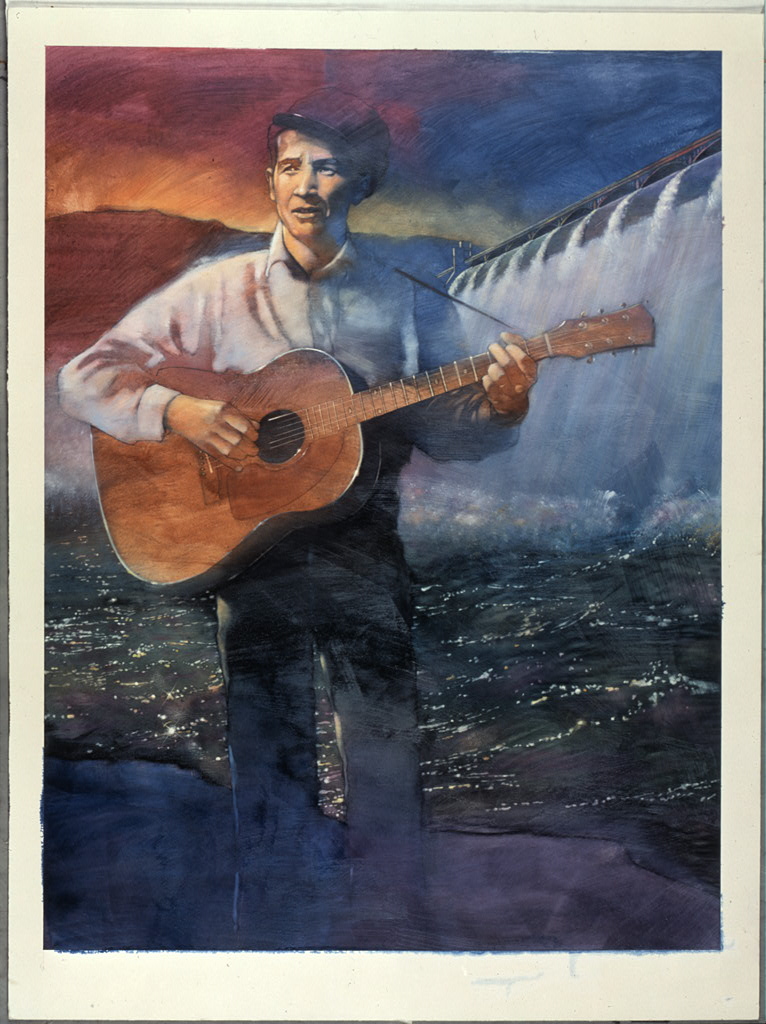
A painting of Woody at the Columbia dam,
about which he wrote some of his greatest
songs
Marjorie forced him to move out when he attacked their son Arlo one day. Woody went into the hospital to cure himself of alcoholism, and a young doctor figured out his problem. He asked Woody questions about his parents and grandparents, and diagnosed him with Huntington’s Chorea, called chorea because of the violent dance-like movements of its victims (the root of the word choreography). Huntington’s Chorea is an inherited degenerative disease and a victim’s offspring stand a fifty-fifty chance of getting the disease. The course of the illness is long and savage.
The changes in Woody occurred so slowly that few of his friends really noticed. Almost everyone chalked it up to drink, or said “Well, that’s just Woody. That’s the way he walks and talks." Some people avoided him now. He slurred his words and staggered and was becoming less and less capable of working at all.

Bob Dylan's copy of Woody's Book
Bound For Glory
When Woody was trying to concentrate, he wrote his name everywhere. . .on walls, on people’s books, on pieces of paper. Woody Guthrie. Woody Guthrie. It was almost as if he was trying to convince himself he really DID exist.
One day he was lighting a fire and the gas can exploded. His arm could no longer hold a guitar very well.
Woody checked into the State Hospital in Queens, and with the exception of visits with friends on weekends, he lived there the rest of his life.
His son, the musician Arlo Guthrie talked about him to Rolling Stone magazine:
“I remember him coming home from the hospital and taking me out to the backyard, just him and me, and teaching me the last verses to This Land Is Your Land because he thinks if I don’t learn them no one will remember. He can barely strum a guitar now and—can you imagine?—his friends think he’s crazy or drunk and they stick him in a green room with all these crazy people…”
“All of a sudden everyone is singing his songs. Kids are singing This Land Is Your Land in school and people are talking about making it the national anthem. Bob Dylan and the others are copying him. And he can’t react to it. Here’s the guy who had all these words and now that he’s really big, he can’t say anything.”
Only Shakespeare could write something that terrible. Woodrow Wilson Guthrie died in 1967, in his fifties. Some experts believe the disease may have enhanced his rhyminess and wordplay, and acted as a creative spur like alcohol and drugs have worked on others.
As the cells died in his brain, it rewired itself, forcing new and wonderful pathways between the nerve synapses. This also led to the not-so-wonderful behavior his family and friends saw. Just like his mother. Starved from all that work, his nerves short-circuited.
Woody and the disease are so bound up together, it’s hard to know where it started and Woody began. No one really knows if the disease starts when you are 14, or in your later years. It cannot be cured. It cannot be predicted in advance. Research is ongoing now, mainly because of what happened to Woody.
Most importantly, of course, is not the disease, but his music and his books. When we sing his most famous song, we sing the first verses. The last verses he tried to teach Arlo are probably politically pink at best, and they were the ones Woody hoped would survive:
In the squares of the city by the shadow of the steeple,Some of the photographs and images of Woody are copyrighted and unlicensed. However, the individual who uploaded this work to Wikipedia, and first used it in an article, as well as subsequent persons who place it into articles, asserts that this use qualifies as fair use of the material under United States copyright law. All This Is That is using the photo under the Fair Use provisions of the copyright act as well, as those provisions apply to scholarly work.
Near the relief office I saw my people
And some were stumbling and some were wondering if
This land was made for you and me.
As I went rambling that dusty highway
I saw a sign that said Private Property
But on the other side it didn’t say nothing.
That side was made for you and me.
---o0o---
Wednesday, February 15, 2006
It's a sign of the times: sex offender registry required for sheep abuser
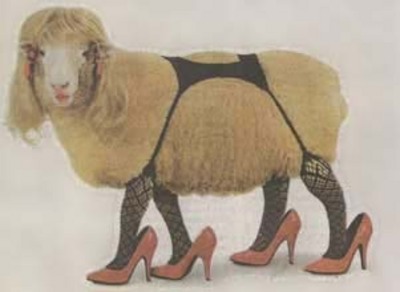
A Michigan man who pleaded nolo contendre to a sodomy charge involving a sheep has been ordered to register as a sex offender. Jeffrey S. Haynes said the state registry is intended to keep track of people who have committed crimes against humans. . .not animals lovers like himself.
Calhoun County Circuit Court Judge, Conrad Sindt, however, told Haynes that once he is released from prison, he must register with the Michigan State Police Public Sex Offender Registry. Click the title of this post to link to the whole sordid story.
Related stories on All This Is That:
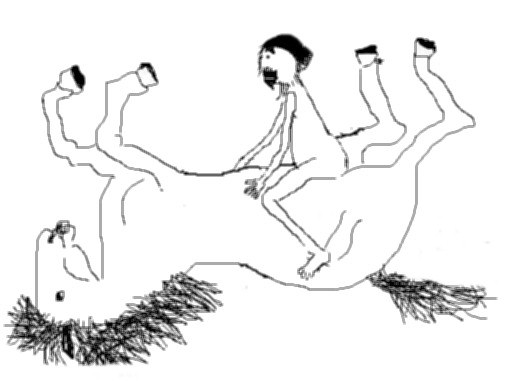
Bestiality In Southeast King County - A Horse Is A Horse Of Course Of Course
Horsin' Around: Update On The Enumclaw Beastiality/Murder Case
Another Shocking Revelation In The Enumclaw Beastiality Case
Further Ruminations On Enumclaw And Beastiality
The Final Enumclaw Horse/Beastiality Update
----------o0o----------
Tuesday, February 14, 2006
Follow-up: Victim of VP's attemped assassination suffers coronary
The 78-year-old lawyer shot by Vice-President Dick Cheney in a hunting "accident" has birdshot lodged in his heart that triggered "a minor heart attack" Tuesday morning, hospital officials said.

You notice how everything about this story is minor? Vice-President Cheney "peppered" the luckless Harry Whittington. He was "peppered" sufficiently enough to be in the Intensive Care Unit a couple of days. And now we learn the birdshot has caused a "minor" heart attack. What's next? Stories in the New York Times and on MSNBC talk about about all the jokes, shockwave games, editorials, Democraric drumbeating, and the general buzz surrounding the story. Just as things were about to quiet down, Mr. Whittington suffered a heart attack. Just him making a joke about the shooting might have scotched the buzz for good. That hasn't happened. . .
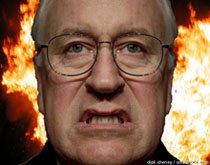
The original story in All This Is That appeared Sunday night. Over five hundred people have read that original posting (not to mention stories on hundreds of other blogs and web sites) which began as satire and seems to have now become almost straight ahead reportage. In fact, the rumors about the Secret Service, and the manner in which the story was released have increased in intensity and my original satire has been dwarfed by the dark stories now circulating about the "incident."
Google searches leading here include phrases like "Cheney shooting conspiracy," "Dick Cheney Secret Service coverup," "Vice President attempted murder," "Cheney rumors" Cheney resignation," and "Cheney drunk while hunting?" This is very strange indeed. Between Scooter Libby's indictment, the allegations of domestic spying, and all the other Republican craziness, this hunting accident has coalesced to form a perfect storm swirling around the head of the Vice-President.
---o0o---

You notice how everything about this story is minor? Vice-President Cheney "peppered" the luckless Harry Whittington. He was "peppered" sufficiently enough to be in the Intensive Care Unit a couple of days. And now we learn the birdshot has caused a "minor" heart attack. What's next? Stories in the New York Times and on MSNBC talk about about all the jokes, shockwave games, editorials, Democraric drumbeating, and the general buzz surrounding the story. Just as things were about to quiet down, Mr. Whittington suffered a heart attack. Just him making a joke about the shooting might have scotched the buzz for good. That hasn't happened. . .
The original story in All This Is That appeared Sunday night. Over five hundred people have read that original posting (not to mention stories on hundreds of other blogs and web sites) which began as satire and seems to have now become almost straight ahead reportage. In fact, the rumors about the Secret Service, and the manner in which the story was released have increased in intensity and my original satire has been dwarfed by the dark stories now circulating about the "incident."
Google searches leading here include phrases like "Cheney shooting conspiracy," "Dick Cheney Secret Service coverup," "Vice President attempted murder," "Cheney rumors" Cheney resignation," and "Cheney drunk while hunting?" This is very strange indeed. Between Scooter Libby's indictment, the allegations of domestic spying, and all the other Republican craziness, this hunting accident has coalesced to form a perfect storm swirling around the head of the Vice-President.
---o0o---
Poem: Ten ways of looking at lies
1.
A lie is situational
Mine tend to reducing
Or blowing up the fact
2.
Speak with a forked tongue
But make sure each tine
Knows what the other is saying
3.
There is danger
Lying in cahoots
Collate your lie with the other lie
4.
It travels in many guises
Animal scat hype shuck and jive
Prevarication stretching spoofing
5.
Common targets of falsehood
The po-lice the confessional
Your boss your boss's boss
Your parents surveys
The priest anyone over 40
The insurance adjustor
6.
Lies are like rabbits
They keep breeding
Until the range is overrun
7.
The safest lie
Is the one
Only you know
8.
The first one caught
takes the heat.
9.
"And after all, what is a lie? ’T is but
The truth in masquerade"
10.
The truth exists
The lie must be created.
---o0o---
No. 9 is a quote from a poem by George Gordon (Lord Byron)

A lie is situational
Mine tend to reducing
Or blowing up the fact
2.
Speak with a forked tongue
But make sure each tine
Knows what the other is saying
3.
There is danger
Lying in cahoots
Collate your lie with the other lie
4.
It travels in many guises
Animal scat hype shuck and jive
Prevarication stretching spoofing
5.
Common targets of falsehood
The po-lice the confessional
Your boss your boss's boss
Your parents surveys
The priest anyone over 40
The insurance adjustor
6.
Lies are like rabbits
They keep breeding
Until the range is overrun
7.
The safest lie
Is the one
Only you know
8.
The first one caught
takes the heat.
9.
"And after all, what is a lie? ’T is but
The truth in masquerade"
10.
The truth exists
The lie must be created.
---o0o---
No. 9 is a quote from a poem by George Gordon (Lord Byron)
Rules for living
1. Never cut your hair or touch up your beard after three margaritas. Or call your boss. Fives.com says you should also not:
1) buy domain names
2) hire an attorney
3) do lots of file management from the command line
4) sort out your finances
5) telephone people you remember fondly from elementary school
2. Everyone seems normal until you get to know them. Mostly. Sometimes someone is so far gone that the tell radiates for blocks. But normally, the benefit of the doubt we give strangers carries the day. Even really wacky folks tend to hold back until "they get the job."
3. When you make a mistake, make amends immediately. It's easier to eat crow while it's still warm. Ask Richard Nixon.
4. Pick your battles wisely. Will this matter one year from now? One month? Tomorrow? Naw...
5. Never pass up an opportunity to pee. I learned this hard fact over the years, sitting in bumper to bumper traffic on the Evergreen Point Floating Bridge or going north on I-405.
6. If you woke up breathing, that is cause enough to celebrate.
7. Know your way home. Even if, and especially if, you're in a foreign country or a strange city. I don't really believe this rule. But I don't panic if I'm lost, either. I don't really believe in the concept of being lost. At any given time, some of us just have a better idea of where we actually are. And to some of us, it doesn't matter. . .we'll get there eventually.
8. You'll feel better if you throw up. That was certainly true in high school drinking days. It's still true. You never feel worse afterwards.
9. Everyone considers themself an above average driver, pretty good in bed, and "smarter than the average bear."
10. A tongue stud, green hair, a tattoo, or extreme facial metalwork is no excuse not to learn to do it right.
11 If someone tells you, "You're dreaming, pal!" kick them in the testicles. They said it's a dream.
12. If someone else enters a public bathroom, cough to let them know you are there. If not, you may have to listen to something neither of you intended.
13. The Sacred Buffer Corollary: When in a public bathroom, never take the urinal/stall directly adjacent to another user/jockey. When you are the first settler, never take the middle facility.
----------o0o-----------
Monday, February 13, 2006
Cover-up: Cheney shooting "was no accident"

The Vice-President chats with aides
following Saturday's shooting mishap
Senior aides to Vice-President Cheney have disclosed to All This Is That startling new details of this weekend's shooting of Harry Whittington by the Vice-President. Aides say the incident was not an accident, as the press has been led to believe. An initial statement given to the press pool said "Vice President Dick Cheney accidentally shot and wounded a companion on a weekend quail hunting trip in Texas, spraying the attorney Harry Whittington with birdshot. "
Harry Whittington, a millionaire attorney from Austin, was reported "alert and doing fine" in a Corpus Christi hospital Sunday. The Vice-President's office did not disclose the accident until nearly 24 hours after it occurred. Mr. Whittington is in stable condition in the hospital's intensive care unit.
According to aides, the story of the accident was patently false. Whittington did not, as the Vice President's office said "come up from behind the vice president and the other hunter without signaling or announcing himself." The initial statement even seemed to make light of the accident: "by god, Harry was in the line of fire and got peppered pretty good."
Aides to Mr. Cheney said The Vice-President was mad that Whittington had spooked a second covey of quail away and angrily pointed his shotgun at him. At least two aides
say Vice-President Cheney intentionally shot at Whittington, believing he was far enough away to escape any shot from the blast. A third aide believes Mr. Cheney pulled the trigger accidentally as a result of one of his now frequent "nerve tremors."The Democratic leadership announced Sunday they would demand a commission look into the charges of cover-up by Vice President's staff, as well as the Secret Service.
---o0o---
Sunday, February 12, 2006
Seven years ago today, Bill Clinton was acquited in his impeachment trial
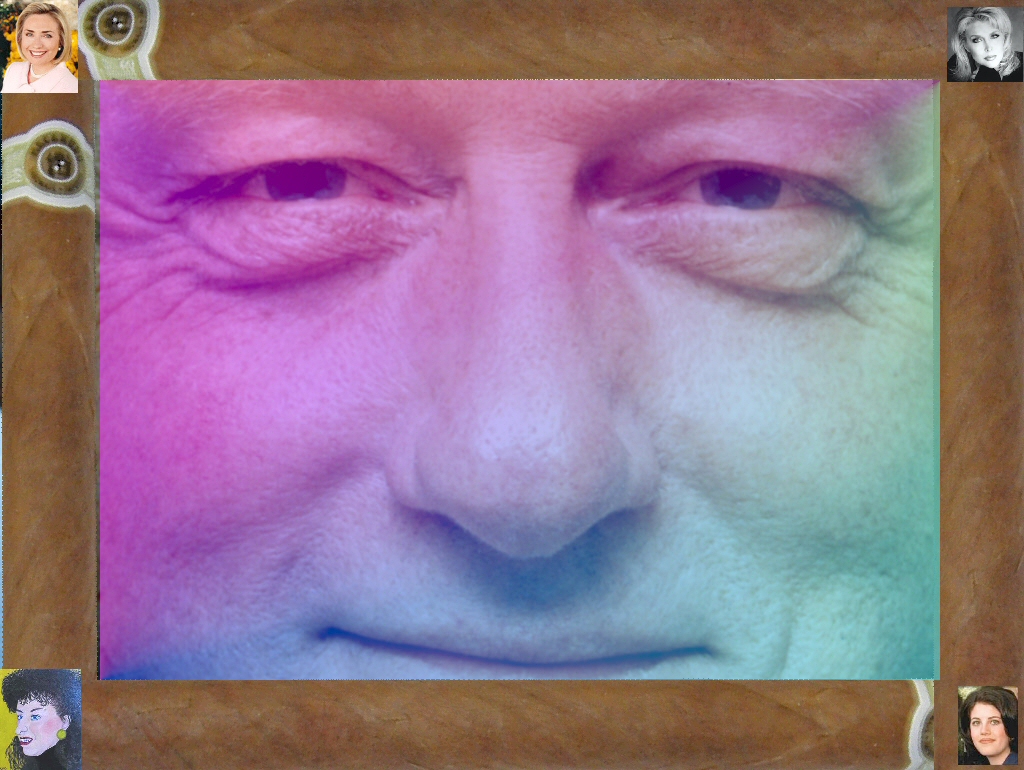
 It was seven years ago today--February 12, 1999--that Bill Clinton's five week impeachment trial came to an end, with the Senate acquitting the President of perjury and obstruction of justice.
President Clinton began an affair with Monica Lewinsky, a 21-year-old intern, in 1995. Over a year and a half, The President and Lewinsky had a dozen furtive encounters in the White House. When she was transferred to the Pentagon in 1996, she confided in Pentagon co-worker Linda Tripp about her trysts with the Commander In Chief.
 Tripp began secretly to record conversations with Lewinsky, pumping for the sordid and tawdry details (and there were plenty). Paula Jones, who was suing the president on sexual harassment charges, for another alleged adventure of The President's, subpoenaed Lewinsky. In January 1998, at the urging of The President (allegedly), Monica filed an affidavit denying having had a sexual relationship with him. Later that week, Tripp contacted the office of Kenneth Starr, the Whitewater independent counsel, to rat out Lewinsky and play him the tapes she made of her talks with her "friend."
Tripp was secretly wired by the FBI and met Lewinsky again. Shortly after that, FBI agents and U.S. attorneys questioned Monica and offered her immunity if she cooperated. When the story first broke, President Clinton said "I did not have sexual relations with that woman."
In late July, lawyers for Lewinsky and Starr worked out a full-immunity agreement covering both Lewinsky and her parents. Starr had threatened them all with prosecution.
----------o00----------
Subscribe to:
Posts (Atom)