Sunday, June 24, 2012

Visiting a redeveloped Hutong and Shichahai Lake in Beijing

By Jack Brummet, China Travel Editor

Hutongs (simplified胡同traditional: 衚衕) are narrow streets or alleys


"most commonly associated with BeijingChina. In Beijing, hutongs are alleys formed by lines of siheyuan, traditional courtyard residences. Many neighbourhoods were formed by joining one siheyuan to another to form a hutong, and then joining one hutong to another. The word hutong is also used to refer to such neighbourhoods," according to Wikipedia, which also says:  "Following the founding of the People’s Republic of China in 1949, many of the old hutongs of Beijing disappeared, replaced by wide boulevards and high rises. Many residents left the lanes where their families lived for generations for apartment buildings with modern amenities. In Xicheng District, for example, nearly 200 hutongs out of the 820 it held in 1949 have disappeared."However, many of Beijing’s ancient hutongs still stand, and a number of them have been designated protected areas. The older neighborhoods survive today, offering a glimpse of life in the capital city as it has been for generations."Many hutongs, some several hundred years old, in the vicinity of the Bell Tower and Drum Tower and Shichahai Lake are preserved amongst recreated contemporary two- and three-storey versions. This area abounds with tourists, many of which tour the quarter in pedicabs."

Shichahai Lake contains three lakes: Qianhai (前海)Xihai (西海) and Houhai (后海).  I don't know which of these three lakes we strolled around, but it was the one lined with bars and restaurants.  A promenade between the shops and the lake ran all around the lake.  It was a fascinating walk, and we were only subtly hustled by a few women and greeter types, asking if we wanted to go to "a lady bar."


Strolling through the hutongs was fascinating, and I hope to visit others on my next trip to Beijing. . .

The Hutong we visited had some residents along the side alleys, but along the main alleys and streets, the houses had been redeveloped into shops.  This is much preferable to the usual alternative--they are often razed to make way for large, characterless apartment buildings.

Jack with Bill Willis outside a tree-lined alleyway

Kids out for the night, and one of the few cop cars I saw the whole time I was in Beijing

three policemen in the shadows


this unit looked like it was still being lived in--you saw a few outliers along the main streets

Liang Liu, Leon Yao, and Bill Willis


trinkets

flags


a hostel in the Hutong


 Shichahai Lake contains three lakes - We walked all around this one (it's about a mile around), but I'm not sure which one this is!  The lakes are Qianhai (前海)Xihai (西海) and Houhai (后海).


this was a typical bar around the lake - the music was usually western pop/folk (I heard some Carpenters, Beatles, and Bob Dylan).

---o0o---

Digital art: At Mao's gate

---o0o---

Saturday, June 23, 2012

A racy statue in Beijing's central business district

By Jack Brummet, China Editor

I stumbled onto this interesting sculpture not far from our office in Beijing's CBD. . .

---o0o---

Friday, June 22, 2012

The foul-mouthed baseball players of 1897

By Pablo Fanque, Sports Editor

This letter was found in 2007 in the papers of the baseball historian Al Kermish, who was also a baseball ephemera collector.   The memo contains so many raunchy quotes that the league declared it "unmailable" via the post office, and was thus hand-delivered to the league's twelve ball clubs.  


click to enlarge


SPECIAL INSTRUCTIONS TO PLAYERS

In a contest between two leading clubs during the championship season of 1897, the stands being crowded with patrons of the game, a gentleman occupying a seat in the front row near the players' bench, asked one of the visiting players who was going to pitch for them. The player made no reply. He then asked a second time. The gentleman, his wife who sat with him, and others of both sexes, within hearing distance, were outraged upon hearing the player reply in a loud, brutal tone, "Oh, go fuck yourself."

On being remonstrated with by his fellow-players, who told him there were ladies present, he retorted he didn't give a damn, that they had no business there anyhow.

This shocking indecency was brought to the attention of the League at the Philadelphia meeting in November, 1897, and a committee was appointed to report upon this baseball crime, define and suggest for it a remedy.

In response to nearly one hundred communications addressed to umpires, managers and club officials, soliciting definite, positive and personal knowledge of obscene and indecent language upon the ball field, the committee received a deluge of information that was so appalling as to be almost beyond belief, showing conclusively and beyond contradiction that there was urgent need for legislative action on the part of the League.

That such brutal language as "You cock-sucking son of a bitch!" "You prick-eating bastard!" "You cunt-lapping dog!" "Kiss my ass, you son of a bitch!" "A dog must have fucked your mother when she made you!" "I fucked your mother, you sister, your wife!" "I'll make you suck my ass!" "You cock-sucker!" and many other revolting terms are used by a limited number of players to intimidate umpires and opposing players, and are promiscuously used upon the ball field, is vouched for by the almost unanimous assertion of those invited to speak, and who are competent to speak from personal knowledge. Whether it be the language quoted above, or some other indecent and infamous invention of depravity, the League is pledged to remove it from the ball field, whether it necessitates the removal of the offender for a day or for all time. Any indecent or obscene word, sentence, or expression, unfit for print or the human ear, whether mentioned in these instructions or not, is contemplated under the law and within its intent and meaning, and will be dealt with without fear or favor when the fact is established by conclusive proof.

By Order of the Committee.

[UNMAILABLE. Must be forwarded by Express]

---o0o---

Soup dumplings, a/k/a Xiaolongbao, in Beijing last week

By Jack Brummet, China travel and restaurant editor


After our trip to Beijing's Forbidden City last Friday, my friend Liang took me out for soup dumplings in Beijing.  The restaurant was glitzy, on the top floor of a fashionable atrium style mall that sold very high end consumer goods like Coach handbags, diamonds, Brooks Brothers, perfume stores, and all sorts of gear for the disposable income set. 

A bamboo steamer with Shanghai hairy crab soup dumplings (Xiaolongbao)

The dumplings, or, Xiaolongbao, are traditionally filled with pork, but variations include other meats, seafood and vegetarian fillings. The soup-filled kind are created by wrapping solid meat aspic inside the skin alongside the meat filling. Heat from steaming then melts the gelatin-gelled aspic into soup. They are just amazing.  We had a great lunch of a little bit of grilled pork, a plate of sauteed spinach, some soup, and three varieties of Xiaolongbao: vegetable, pork, and Shanghai Hairy Crab a/k/a mittens crab.  They're not actually hairy, but like our local Dungeness crabs, their claws look hairy.  The hairy crab is actually a freshwater crab that only goes into saltwater to breed and later to fetch their young uns.  Soup dumplings have recently become a very hot item in the Seattle area, with a couple of restaurants serving them and people waiting on line for two hours to get in. . .

Liang

I think I can reverse engineer these fairly easily.  I think the main trick will be in sealing the dumplings, which are not dropped into boiling water, but steamed in bamboo steamers.  Making the aspic will probably be the only big P.I.T.A.

Lunch
---o0o---

Thursday, June 21, 2012

Alien Lore Mo. 234 - The sounds and music we sent into deep space on the Voyager (1977)

By Jack Brummet, NASA and Alien Lore Editor


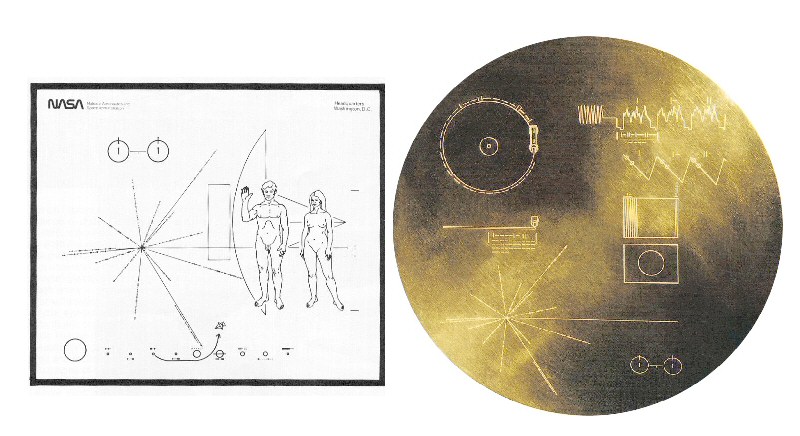
The picture on the left went into space with our early interstellar craft (The Pioneers). It explains where earth is, what homo sapiens sort of looked like naked (like Barbie and Ken), and other information, like a diagram indicating the location of our sun. 

Nasa's Jet Propulsion Lab (JPL) worked on this "Interstellar Outreach Program" for many years. The gold-plated disk is from the two Voyager craft, launched after the Pioneer.  It 
is a bronze record containing sounds and images of life on earth. Each of the two Voyagers is equipped with a record player of sorts--with a cartridge, even--to play the disk, and recover the images. 

The two circles in the bottom right side of the record show the two lowest states of a hydrogen atom. The vertical lines on the circles show the spin moment of the electron and proton. And (is this cool, or what?) "the transition time from one state to the next provides the fundamental clock reference used in ALL the cover diagrams and the images to be decoded from binaries."  [Ed's note: Obviously, they're not expecting a dork like me to find the record laying around somewhere in the future].

Carl Sagan and a team of other folks designed and selected the Voyager's messages and data. The disk includes a greeting in 55 different languages, from Aramaic to Vietnamese. The record also includes a sampler of non-human Earth sounds such as wind, rain, surf, chimps, sheep, crickets, saws, and trains. It contains photos as well, and maps, diagrams of DNA, vertebrate anatomy charts, chemical and mathematical definitions, and other visual displays. The disk includes Beethoven, a Chuck Berry tune (Johnny B, Goode), Bach and Mozart, a Navajo chant, Indian Ragas, and a Louis Armstrong recording. There are 116 binary images on the record. 

No one know if the aliens who find this will be able to use it, or decode the information. Will they even have hands? Opposable thumbs? Will they even think in any path parallel to ours? Will the disk just look like gibberish to them? Their scientists--if they have science (and we assume they must)--may need to study the disk for a couple of thousand years before they make a breakthrough. 

A book titled Murmurs of the Earth, written by Sagan and colleagues, was reissued in 1992 with a CD-ROM compilation of the Golden Record, and a description of its creation. It's out of print, but you can pick up a copy fairly cheaply. 


Don't hold your breath that any of our cousins in other galaxies will find this and come to visit. The Voyager will not come close to another star for something like 40,000 years. But then again, when you're dealing with our alien cousins Out There, 40,000 years may just be a sneeze in the winds of time. 


Sounds included on the Voyager record:


  • Music of The Spheres (WTF is this!?)
  • Volcanoes, Earthquake, Thunder
  • Mud Pots
  • Wind, Rain, Surf
  • Crickets, Frogs
  • Birds, Hyena, Elephant
  • Chimpanzee
  • Wild Dog
  • Footsteps, Heartbeat, Laughter
  • Fire, Speech
  • The First Tools
  • Tame Dog
  • Herding Sheep, Blacksmith, Sawing
  • Tractor, Riveter
  • Morse Code, Ships
  • Horse and Cart
  • Train
  • Tractor, Bus, Auto
  • F-111 Flyby, Saturn 5 Lift-off
  • Kiss, Mother and Child
  • Life Signs, Pulsar


Music:


  • Bach, Brandenburg Concerto No. 2 in F. First Movement, Munich Bach Orchestra, Karl Richter, conductor. 4:40
  • Java, court gamelan, "Kinds of Flowers," recorded by Robert Brown. 4:43
  • Senegal, percussion, recorded by Charles Duvelle. 2:08
  • Zaire, Pygmy girls' initiation song, recorded by Colin Turnbull. 0:56
  • Australia, Aborigine songs, "Morning Star" and "Devil Bird," recorded by Sandra LeBrun Holmes. 1:26
  • Mexico, "El Cascabel," performed by Lorenzo Barcelata and the Mariachi México. 3:14
  • "Johnny B. Goode," written and performed by Chuck Berry. 2:38
  • New Guinea, men's house song, recorded by Robert MacLennan. 1:20
  • Japan, shakuhachi, "Cranes in Their Nest," performed by Coro Yamaguchi. 4:51
  • Bach, "Gavotte en rondeaux" from the Partita No. 3 in E major for Violin, performed by Arthur Grumiaux. 2:55
  • Mozart, The Magic Flute, Queen of the Night aria, no. 14. Edda Moser, soprano. Bavarian State Opera, Munich, Wolfgang Sawallisch, conductor. 2:55
  • Georgian S.S.R., chorus, "Tchakrulo," collected by Radio Moscow. 2:18
  • Peru, panpipes and drum, collected by Casa de la Cultura, Lima. 0:52
  • "Melancholy Blues," performed by Louis Armstrong and his Hot Seven. 3:05
  • Azerbaijan S.S.R., bagpipes, recorded by Radio Moscow. 2:30
  • Stravinsky, Rite of Spring, Sacrificial Dance, Columbia Symphony Orchestra, Igor Stravinsky, conductor. 4:35
  • Bach, The Well-Tempered Clavier, Book 2, Prelude and Fugue in C, No.1. Glenn Gould, piano. 4:48
  • Beethoven, Fifth Symphony, First Movement, the Philharmonia Orchestra, Otto Klemperer, conductor. 7:20
  • Bulgaria, "Izlel je Delyo Hagdutin," sung by Valya Balkanska. 4:59
  • Navajo Indians, Night Chant, recorded by Willard Rhodes. 0:57
  • Holborne, Paueans, Galliards, Almains and Other Short Aeirs, "The Fairie Round," performed by David Munrow and the Early Music Consort of London. 1:17
  • Solomon Islands, panpipes, collected by the Solomon Islands Broadcasting Service. 1:12
  • Peru, wedding song, recorded by John Cohen. 0:38
  • China, ch'in, "Flowing Streams," performed by Kuan P'ing-hu. 7:37
  • India, raga, "Jaat Kahan Ho," sung by Surshri Kesar Bai Kerkar. 3:30
  • "Dark Was the Night," written and performed by Blind Willie Johnson. 3:15
  • Beethoven, String Quartet No. 13 in B flat, Opus 130, Cavatina, performed by Budapest String Quartet 6:37

---o0o---

Wednesday, June 20, 2012

Photos and notes from Beijing's Forbidden City

By Jack Brummet, China Travel Editor 

The Forbidden City紫禁城, literally translated by most as The Purple Forbidden City,  was the Chinese imperial palace from the Ming Dynasty to the end of the Qing Dynasty. It is located smack dab in the middle of Beijing, and now houses the Palace Museum, who run the place. For almost 500 years, it was the home of emperors and their households, as well as the ceremonial and political center of China's government. Mao Zedong later lived just on the edge of the city.  The site includes an amazing 780 buildings on about eight million square feet (or, 178 acres!).  According to The Wikipedia, in the fifteen years in the Ming period when then city was under construction, it employed one million workers.  I saw a fraction of it in three hours.  I look forward to going back later this year to explore it further. 


Roof guardians - many of the buildings have these wonderful gargoyle sentries

This painting, from the Ming Dynasty period (mid-1400's) depicts the completed Forbidden City looking just about like it does today.


At the gate to the forbidden city.  In this photo, I am facing Tiananmen Square, just across the way.  Next to the Great Wall, I think this entrance, with the picture of Mao Zedong (who in my youth was still known as Mao Tse Tung), is probably the most photographed image in all of China.

a plan of the Forbidden City from Airphoto International - it only shows the largest structures

There are wonderful images of dragons all around the Forbidden City.


A lion that was carved almost six hundred years ago guards the entrance.  I wonder if these have been restored?  You would think the air pollution in Beijing would make short work of them, but they look like they could have been carved this year.  In Seattle, we have two ancient Egyptian sculptures of camels outside our Asian art museum on Capitol Hill.  About 20 years ago, they brought them inside and put copies outside.  They did the same thing in Florence with massive statue of David.  These lions are tough!

Yeah, I was bad about writing down the names of buildings.  I can only name a few of them.

It's virtually impossible to take a photo without someone (or hundreds) of tourists in it


Most of the interiors are closed off, but you can see in to the throne and sitting rooms

Many of the buildings have these vast bronze cauldrons (some covered in gold leaf) out front.  They were the Ming equivalent of fire hydrants.  They were always kept filled with water in case of fire; in the winter, they would keep fires lit beneath them to keep the water from freezing.  When a fire broke out, presumably some sort of bucket brigade sprung into action.  I'm not sure how effective these were--many  buildings, mostly built in the early 15th century eventually burned down and were reconstructed.


Just when you think you are at the end of the city, you stumble upon a new row of buildings.

This is a 200 ton sculpture that was quarried and carved far away from Beijing.  It was brought to the Forbidden City (presumably by slaves).  We know it was transported on the road in the winter.  They would pour water on the road, and drag the sculpture fifty feet and begin the water/freeze/drag procedure once again.  I wonder how many slaves it took to push 200 tons of rock across the iced roads?


This was just amazing.  It is not sculpted or carved.  It is a pile of gigantic, fantastically shaped rocks that they built a hill from and then topped it with a pagoda.  The Emperor would come here with his wife on special occasions and climb up the hill into the pagoda.
---o0o---

Tuesday, June 19, 2012

Photos and notes from Tiananmen Square, Beijing

By Jack Brummet, China Travel Editor

Tiananmen Square is El Centro of China; the very heart of the country.  The Communist Party began building the square after the 1949 revolution.  It was the parade ground upon which The Party would hold its massive parades of soldiers, tanks, and missiles.  Eventually, it would contain Mao Zedong's tomb, and many other museums, monuments, and memorials.  TS sits squarely in the center of BeijingChina, and is named after the Tiananmen Gate (Gate of Heavenly Peace--a phrase lifted from the I Ching) just across the street to its North, and a few hundred feet south of the Forbidden City. Tiananmen Square is one of the largest city squares in the world--roughly 100 acres.  It has enormous cultural significance as the site of numerous important events in post-revolution Chinese history.  


Almost every citizen I asked about the square didn't want to talk about what happened there in 1989. They didn't refuse to talk about it, but their answers were always a little muddy and vague.  To us, outside China, the square is known as the focal point of the protests of 1989, the pro-democracy movement which abruptly ended on June 4th, 1989, with a declaration of martial law in Beijing, the iconic images of a tank killing a protester, and the death of several hundred civilians.  It was a sobering visit for me, partly because no one really wants to discuss what happened with an obscure American blog site.  People seem aware of what happened, but no one was willing to open up on how it affected the citizens. In any case, this is one of the most popular tourist sites in China.  There were literally thousands of Chinese tourists the day I visited there, and maybe one or two dozen Europeans and Americans.  


Tiananmen Square is the biggest square I have ever seen (the biggest square I've seen prior to this was El Plaza Mayor in Madrid--a mere 129 by 94 metres).  There are many beautiful and culturally significant features, but for me it was impossible to be there without remembering the savage beatdown the Party put down on its citizens in  1989.  I was utterly unable to determine what the events of June 4th mean to the regular folk in China; I encountered the same reticence every time I asked people about membership in the Communist Party.


This photo captures maybe one third of the vastness of Tiananmen Square.  The building you see
directly in front, behind the red video screen on the right, is Mao Zedong's tomb.

A view of the Great People's Hall


 I didn't verify this, but these two video displays (this is just one--roughly 150 feet wide--may be the biggest have ever seem.  They mostly display scenes from various parts of China and messages for The People.  

The obelisk is a memorial for fallen soldiers.

The leading edge of a sculpture just to the left of Mao Zedong's temple 
(in which the taxidermied Mao Zedong is available for viewing three hours a day).

Another view of the sculpture outside Mao's memorial.  Someone just pointed out to me that they 
thought this sculpture resembled the famous photograph of Americans planting the flag on Iwo Jima. 

Mao Zedong's tomb, which closed at noon, frustrating hundreds of Chinese tourists


The next few shots are of the colorful topiaries on the west side of the square.


The flag

A six hundred year old lion sculpture

---o0o---

Alien Lore No. 232 - The Dyatlov Pass incident

By Jack Brummet
Alien Lore and Paranormal Editor


The Dyatlov Pass incident  is one of the creepiest and spookiest stories of the 20th century.  What happened there has been ascribed to Sasquatches/Yeti/Abominable Snowmen, covered up government "experiments," and, of course, The Greys.


Let's start with the facts (of which there are few, since there were no survivors and there are many clues that the Soviets may have suppressed some/most of the facts and findings).


High in the Ural mountains on the night of February 2, 1959, nine murders [probably] occurred. Of course, if the perpetrator(s) happened to be bears or another animal, it wasn't murder at all but another unfortunate man vs, beast encounter.  The incident happened on the east shoulder of the mountain Kholat Syakhl, or, Холат Сяхл.  The pass, where the bodies were found has since been renamed Dyatlov Pass, or, Перевал Дятлова, after the leader Igor Dyatlov.  Nine skier/hikers were found dead on the pass.  The best the Soviet investigators came up with was that "a compelling unknown force" caused the deaths. 


Contemporary Investigators on the scene believed that the hikers tore or cut open their tent from inside and escaped barefoot (they left their boots behind) into the night temperature of just above 0 degrees Fahrenheit.  It appeared to the investigators as if they were trying to escape something inside the tent. The bodies showed no signs of struggle (e.g., no defense wounds), but two victims had fractured skulls, and two had broken ribs and massive internal injuries more consistent with a car accident than an encounter with humans or animals.  One of the hikers tongues had been removed.  The hiker's clothing was later tested, and was found to be radioactive.


Only the hikers footprints were found--there was no sign of any other humans or animals.  


Like all classic 20th Century mysteries involving groups of missing persons or enigmatic deaths, there is a group of UFOlogists convinced that UFOs or The Greys had something to do with the slaughter.


Lev Ivanov, the lead Soviet investigator, collected a report from a group of hikers suggesting that something extraterrestrial might have resulted in the Dyatlov Team’s murders.  The hikers camped in an area 32-miles south of Kholat-Syakhl that night, and saw a series of “strange orange spheres” in the northern sky.  For the next month and a half, other residents in the region reported similar objects in the night skies. 
Ivanov himself actually believed that these spheres might have a link with the deaths. In a 1990 interview, Ivanov claimed that he was ordered to close the case and classify the findings as secret.
Officials were worried that reports of UFOs in the area by multiple eyewitnesses — including people in the  military and weather service — could result in some unnecessary speculation, or panic.  Ivanov told a newspaper reporter "I suspected at the time, and am almost sure now, that these bright flying spheres had a direct connection to the group’s death.”
One thing not mentioned in this video is that a note was found near the campsite that said "from now on we know there are snowmen."


A photo gallery, including the search party photos, can be found here.
---o0o---
All This Is That contains copyrighted material the use of which has not always been specifically authorized by the copyright owner. We make these materials available to advance the understanding of political, economic, literary, artistic, and social issues. In some cases we satirize, parody, or lampoon materials from other sources. We believe this constitutes a 'fair use' of copyrighted material as provided for by section 107 of the US Copyright Law. In accordance with Title 17 U.S.C. Section 107, the material on this site is distributed without profit for research, educational, and entertainment purposes. If you wish to use copyrighted material from this site for purposes of your own that go beyond 'fair use', please read and follow our Creative Commons Attribution 3.0 license and attribute the work to All This Is That, along with our URL (http://jackbrummet.blogspot.com).